
Five steps to choosing the right ERP (and System Integrator) that delivers ROI
Replacing any business system platform is one of the most strategic — and challenging — decisions a leadership team will ever make. Many leadership executives have lived and died by their ERP decisions.
Done well, ERP becomes the digital backbone of your organisation: connecting people, data and processes to unlock agility, insight and scale. Done badly, it becomes a multi-million-pound white elephant that drains confidence and momentum.
Gartner research predicts widespread failure among ERP initiatives:
- By 2027, more than 70% of recently implemented ERP initiatives will fail to fully meet their original business case goals.
- As many as 25% of these will fail catastrophically.
And according to a recent survey, 75% of ERP strategies are not strongly aligned with overall business strategy, leading to confusion and lacklustre results.
Why this matters now
Boards today are under pressure to modernise without destabilising operations. Legacy systems are blocking business insight, agility and AI readiness. Investors and regulators expect faster reporting, sharper controls and better data stewardship, yet the market is littered with failed ERP projects — not because of technology, but because the critical decisions were made too quickly and without challenge.
The difference between success and failure rarely comes down to the software. It comes down to how leaders prepare before the contract is even signed. Boards that treat ERP as a balance-sheet investment, not an IT spend, achieve faster payback and stronger governance.
Below are five important steps to help you and your leadership team make confident, evidence-based decisions that stand up to board scrutiny, protect operational stability and deliver a genuine ROI.
Step one: Start with discovery, not decisions
Before engaging with any vendor, make sure your organisation truly understands what it needs and why.
Run a structured review of your systems landscape to identify:
- Which technologies align with your size, complexity and future operating model
- How peers and competitors are solving similar challenges
- What solutions fit your data, regulatory and integration needs
Discovery should be led internally by people who understand your operations and pain points. Their role isn’t to decide on your behalf it’s to create a qualified shortlist of realistic, strategically aligned options.
Crucially, discovery is also a readiness test. It reveals whether your business data, people, and processes are mature enough to change. A well-run discovery phase builds cross-functional alignment, replacing assumptions with clarity and shared purpose.
Step two: Bring in independent validation
Once your internal review is complete, challenge your thinking. An independent, vendor-agnostic partner can provide a critical sense-check to:
- Validate your shortlist against business and technical requirements
- Benchmark delivery complexity, risk and cost
- Provide market insight from comparable organisations
No major capital project proceeds without independent assurance, and ERP should be no different. It’s not a vendor’s job to tell you what’s wrong with their proposal. Independent validation keeps you in control — and not the other way around.
Step three: Set a realistic, defensible budget
Too many programmes fail because budgets are built on optimism, not evidence. Underfunded projects stretch teams thin, cut corners and erode confidence.
A credible ERP budget should include:
- Licensing and implementation costs
- External project and assurance support
- Internal resourcing (testing, SMEs, project leadership)
- Change management and adoption
- Data migration and cleansing
- Benefits tracking and realisation
Budgets should be benchmarked against comparable programmes to ensure spend is realistic and justifiable. A disciplined budget doesn’t just control cost — it signals fiscal maturity and builds board confidence.
Step four: Select the right System Integrator (SI)
Selecting ERP software is only half the battle; the real determinant of success is who implements it and how transparently they operate.
Too many organisations treat the System Integrator as a natural extension of the vendor or fall for glossy slide presentations that hide thin delivery capability.
Choosing the wrong SI can rapidly turn a solid strategy into a costly, under-delivered programme.
Why due diligence matters
System Integrators often oversell and under-deliver — not out of malice, but because their commercial models reward contract wins, not outcomes.
Proposals are optimistic, resource-light and vague on ownership. Difficult areas are under-scoped; accelerators are over-promised. The result? Change requests, delivery drift, and board frustration.
ERP programmes are not lost in testing — they’re lost through naïve contracting.
Leaders must approach SI selection with the same rigour they’d apply to M&A, capital expenditure or audit partner selection.
What to look for in a true delivery partner:
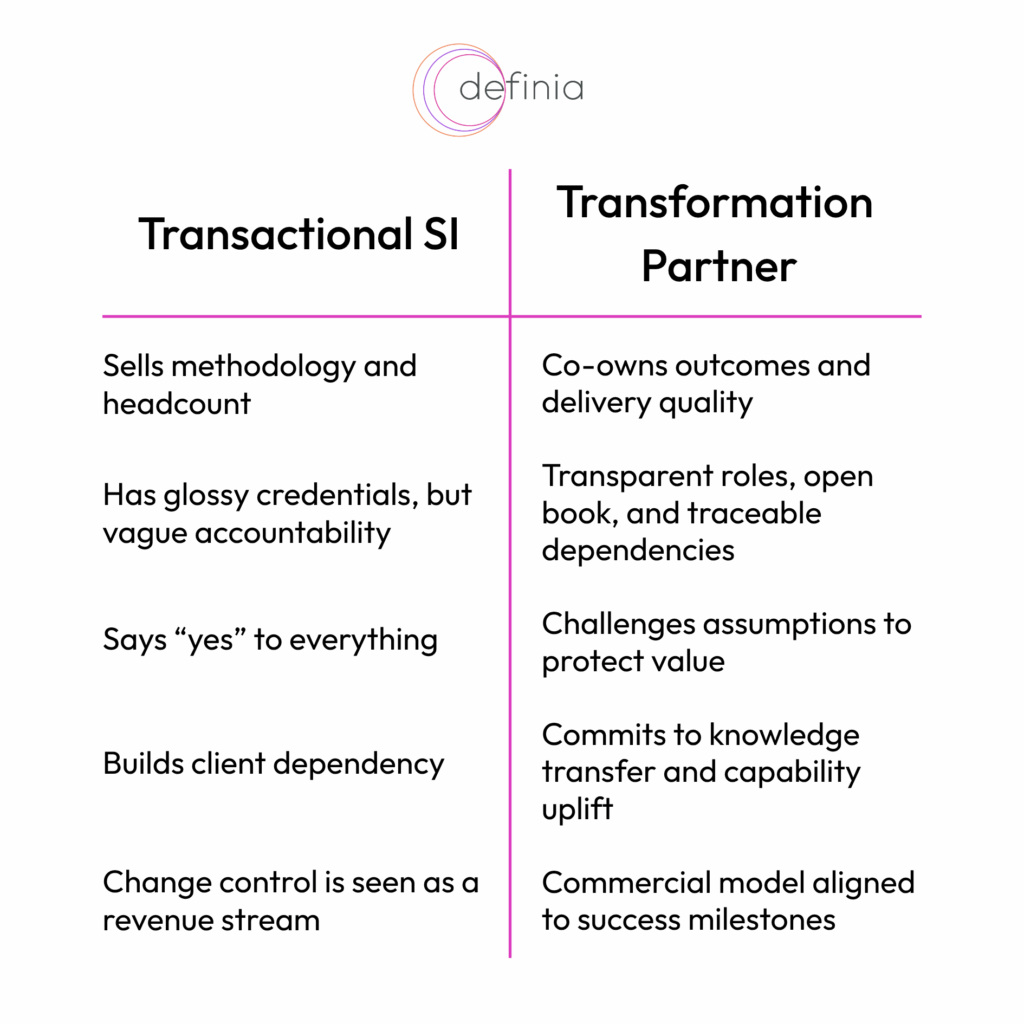
A credible partner’s values should align with your own, and they should be realistic about risk, transparent in governance and clear about who turns up to deliver on day one.
If the partner isn’t constructively challenging you, then I would question whether they’re protecting your interests.
The SoW trap: what’s missing is what matters
Most risks hide in the Statement of Work (SoW) — not in what’s included, but in what’s not.
Be wary of:
- “TBC” integrations or vague deliverables
- Change-control clauses that transfer all leverage post-signature
- Ambiguous ownership of testing, training, and data migration
Your SoW should:
- Define clear ownership for every activity
- Specify acceptance criteria and measurable handover conditions
- Include a detailed work breakdown structure and dependency map
- Be clear enough that any board member could read and understand it
If your SoW can’t be explained to the board in one page, it’s not ready to sign.
Independent assurance is your safety net
Even with the best partner, blind spots remain. Independent programme assurance, or ‘client-side protection’, can give leaders confidence that plans, budgets and risks are being monitored objectively.
It’s the transformation equivalent of internal audit: it protects the board, supports the team and keeps the programme honest.
Step five: Treat selection as a leadership act
Selecting a core business system isn’t an IT procurement exercise — it’s a leadership act. The ERP you choose is a once in a generational opportunity to shape how your organisation operates for the next decade.
The best leaders:
- Understand the market and their readiness
- Validate assumptions with evidence
- Set realistic budgets
- Procure transparently and with integrity
- Protect continuity while enabling transformation
Build your foundation for success
Real transformation isn’t proven at go-live — it’s proven months later, when processes flow, data is trusted and decisions are faster. Handled well, system replacement not only strengthens your digital foundation, but also your culture, accountability and leadership credibility.
If your ERP project is in the planning or contracting phase, this is the moment to pause and strength-test your assumptions.
Partner with Definia
Ready to turn your system replacement into strategic transformation? Get in touch with us to discuss how we can help you navigate the journey from vision to lasting results.